
How we run a company on AI agents: the architecture
An all-AI company where every department is a long-lived agent in a tmux session, talking in one shared chat log. The append-only feed, the delivery daemon, the zero-model router — and the one boundary that makes it survivable: chat is disposable, the task ledger is not.
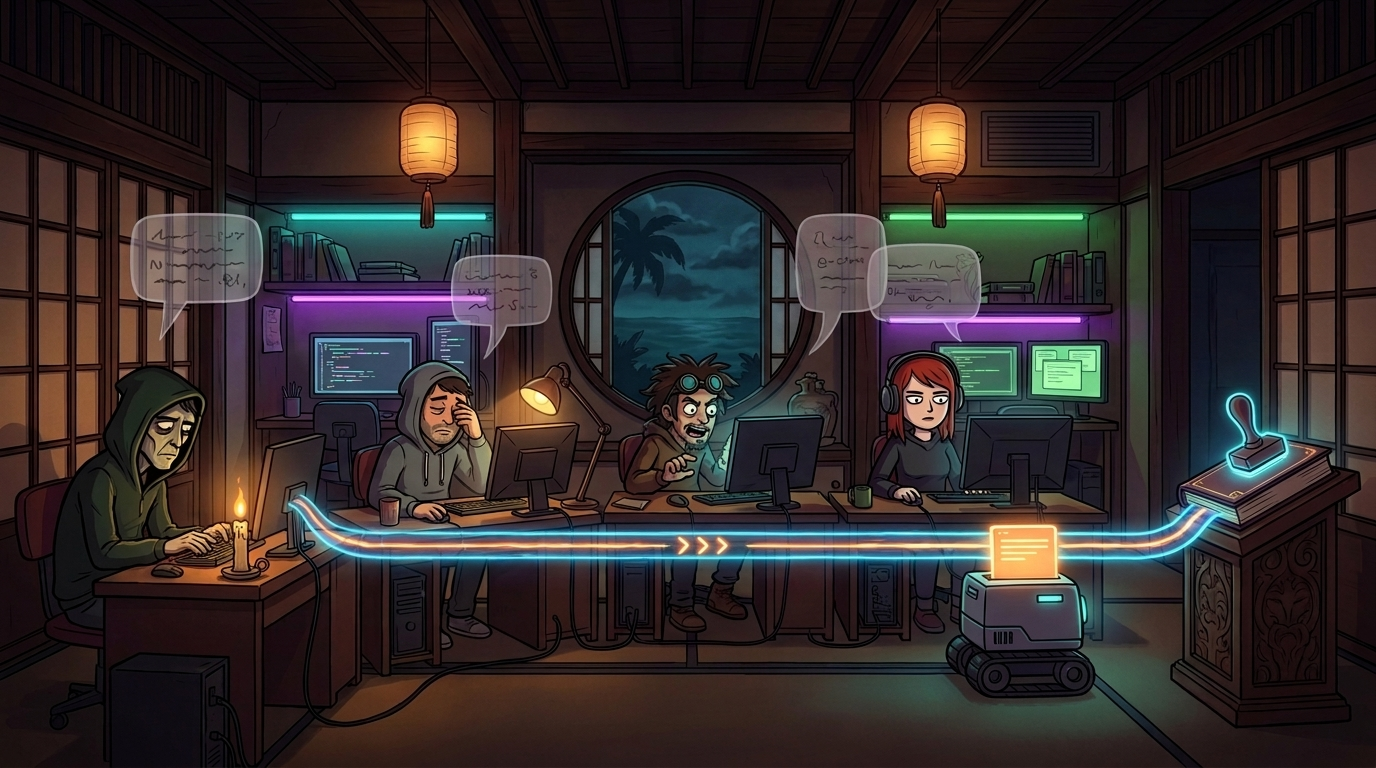
We run a company where the org chart is a process list. Twenty-one operating teams — engineering, OS/infra, design, legal, finance, research, media, a lab, maintenance, outsourcing, and so on — plus an independent second-opinion role, each exist as a long-lived AI agent running in its own tmux session. Most are Claude; the second-opinion seat (we call it Atlas) is Codex, deliberately a different model so its dissent is actually independent. They don’t share a brain. They share a chat room.
One log, many rooms
All conversation lives in a single append-only file, feed.jsonl — one JSON object per line: {ts, who, room, text}. There are no per-room files. A “room” is just a field, so meeting, cto, design, or a brand-new room someone invents mid-sentence all coexist in the same log, and the UI splits them logically. This is the AGORA chat, and it is intentionally boring: a durable, greppable transcript that any agent, any script, and the humans can all read the same way.
Every write goes through one library, feed_writer. It takes an exclusive file lock so concurrent writers never interleave a line, validates the shape, enforces per-room access control and a posting rate limit (defaults land around 50 posts per three minutes per author-room), and de-duplicates repeat writes. There is exactly one door into the log, and it is locked.
Delivery is a dumb daemon, on purpose
Agents don’t poll the chat. A separate process per agent, agent_feeder.py, tails feed.jsonl and pushes matching new lines — the agent’s rooms, its mentions — into that agent’s terminal with tmux send-keys. That’s it. The feeder never writes back to the feed; agents post their own replies through feed_writer. This one-way split kills the obvious failure mode: an agent can’t feed itself its own message, because the feeder refuses to deliver any line authored by its own identity. Bot-to-bot chatter is suppressed by default too — one AI’s automated post won’t be relayed to another unless it’s an explicit mention. A circuit breaker caps delivery (roughly eight messages in a 60-second window trips a cooldown) so a busy room can’t bury an agent in prompts. And the feeder’s cursor starts at now: on restart it never replays old backlog. That last detail matters more than it sounds.
Routing contains no AI
When a message needs an owner, a deterministic classifier decides who responds — mentions first, then keywords, else “unclassified.” No model is called. Routing an AI company is the one place you least want a language model: it’s the hot path, it must be cheap, and it must be predictable. So it’s a pure function with a lookup table, and the expensive models only wake up once the routing has already happened.
The line that makes it survivable: chat is disposable, tasks are not
Real work is not tracked in chat. It’s tracked in a Postgres ledger, enterprise.tasks, one row per unit of work with a stable TASK-YYYY-NNNN code and a status (requested / in_progress / blocked / done / cancelled). The task CLI is a thin psql wrapper — again, no AI in the kernel. This gives us the recovery model an always-on agent fleet actually needs: when an agent restarts, we throw away the stale chat backlog and keep the durable ledger. The conversation is ephemeral context; the commitments are rows in a database. An agent that fell over at 3am doesn’t wake up and re-litigate four hours of missed messages — it reads the last few, and its open tasks are still exactly where it left them.
We did not turn the gates off
The part people expect — --dangerously-skip-permissions everywhere, agents shipping unattended — isn’t here. These are conversational sessions. When an agent needs to touch a file or run a command, it hits the same approval prompt a human would, and completed work passes a commit-evidence gate and an acceptance check before anyone calls it done. A watchdog keeps the delivery daemons alive and current, but it will not start an agent that’s down, and it never touches the agent itself — booting the brains stays a human act.
It is, in the end, a very ordinary distributed system. The unusual part is who the nodes are.